
Saturday SkyWatch 20th Jun 2026
🌅 Sunset & Observatory Hours
- Sunset: 5:06 PM
- Nautical Sunset: 6:06 PM
- Astronomical Sunset: 6:37 PM
This Saturday we will be open from sunset till late (around 9:30 – 10:00 PM).
☁️ Weather & Viewing Conditions
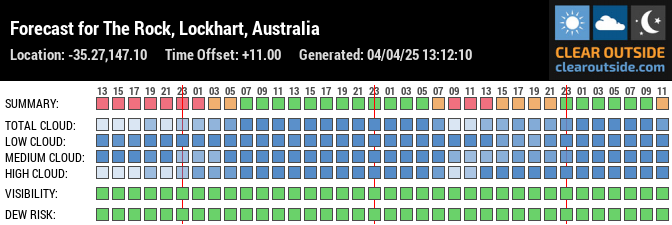
Click on the widgets to visit the parent weather sites for a longer, more detailed forecast.
B.O.M. Forecast for The Rock: http://www.bom.gov.au/places/nsw/the-rock/
To learn how to read the Clear Outside forecast page, follow this link: https://clearoutside.com/page/how_to_use/

Moon Phase
Waxing Crescent (33.3 % illumination), 5.2 days old, and sets at 10:52 PM. A darker sky evening for great observations of dim objects.
ℹ️ Other Information
We recommend to bring a jacket as the weather turns cooler. As always feel free to bring a picnic blanket, some snacks and non-alcoholic refreshments. Please don’t forget to bring your Aeroguard or Bushmans in case of mosquitoes or other annoying insects.
🔭 In the Sky Tonight
Note that just because these objects are in the sky at the moment, you may not always see them. Visibility is dependent on weather, moon brightness, atmospheric conditions, and equipment parameters. Check the weather and viewing conditions above, and if in doubt ask a friendly volunteer if you’re able to see an object in the night sky!
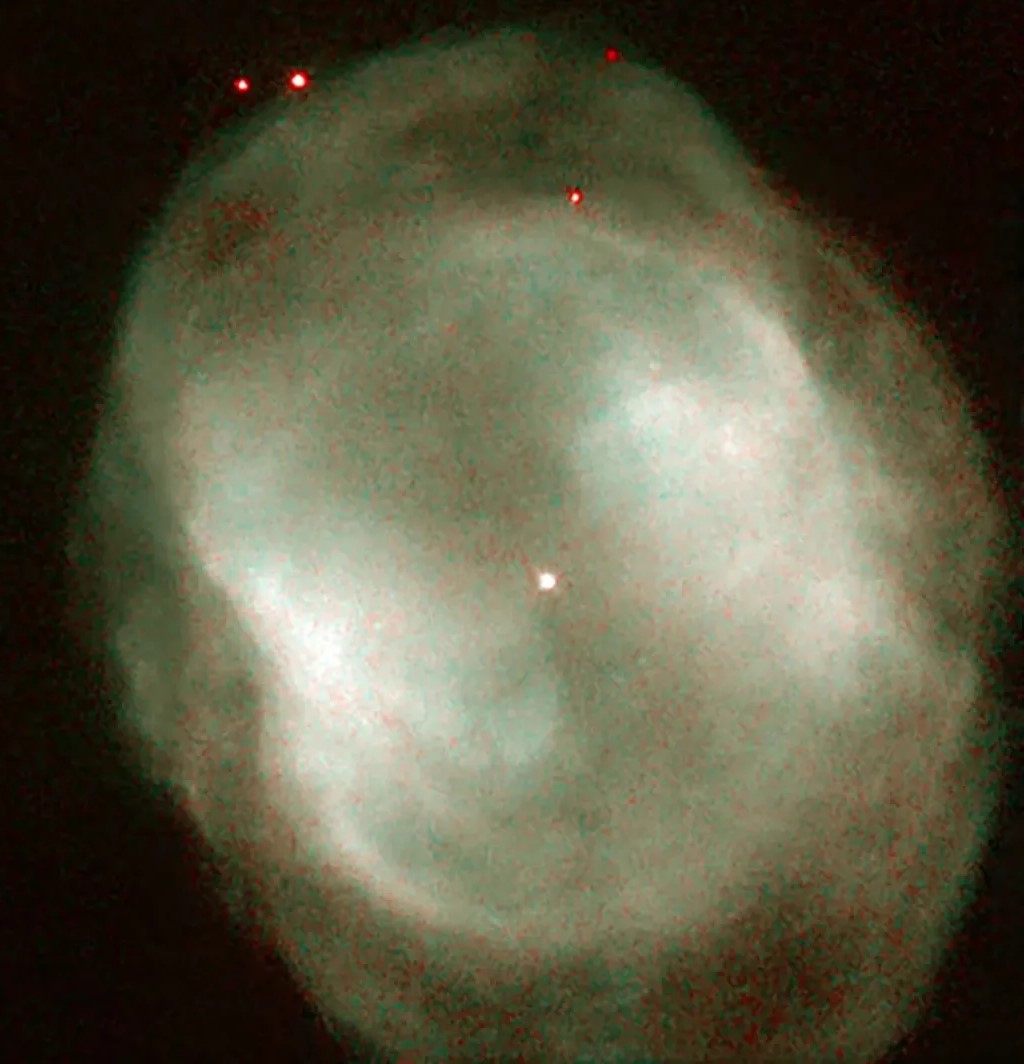
Feature Object: NGC 3195 (Planetary Nebula)
NGC 3195 (also known as Caldwell 109) is a planetary nebula located in the southern constellation of Chamaeleon resembles a phantom snowball. Discovered by Sir John Herschel in 1835, this 11.6 apparent magnitude planetary nebula is slightly oval in shape, with dimensions of 40×35 arc seconds, and can be seen visually in telescopes having an aperture of 200mm or more. The glowing shroud of gas was shed by its central star in a final act before dying.
Spectroscopy reveals that NGC 3195 is approaching Earth at 17 kilometres per second, while the nebulosity is expanding at around 40 kilometres per second. The central star is listed as 15.3 or 16.1 magnitude. Analysis of data suggests that the central star is a binary system. with a distance estimated at 5,500 light-years.
When the star began to exhaust its hydrogen fuel there wasn’t enough pressure to fight off gravity. The core began to contract, becoming denser and hotter, triggering the fusion of helium into carbon. The heat produced caused the star’s outer layers of gas to expand, transforming the star into a red giant. After spending about a billion years as a red giant, the star began a 10,000-year process to shed its outer layers of gas, ultimately uncovering the remaining core of the star — a white dwarf. High-energy radiation from the white dwarf makes the cast-off gaseous layers glow, creating a ghostly specter in the night sky. In tens of thousands of years, Caldwell 109 will fade into darkness as the white dwarf cools like an ember until it finally burns out completely.
Planetary nebulae like Caldwell 109 are especially interesting to scientists because they represent a future stage of our own Sun, which is destined to meet a similar fate in about 6 billion years.
Prominent Constellations
Chamaeleon, Dorado, Carina, Scorpius, Vela, Puppis, Lupus, Centaurus, Corvus, Crater, Coma Berenices, Antlia, Ara, Ophiuchus, Norma, Reticulum, Serpens, Canis Major, Cancer, Virgo, Leo, Lepus, Bootes, Monoceros, Hydra, Circinus, Triangulum Australe, Crux, Musca, Tucana, Pavo.
Celestron Alignment Objects
Sirius, Alpha Centauri, Canopus, Procyon, Acrux, Miaplacidus, Jupiter, Venus
Other Bright Stars
Adhara, Alphard, Aludra, Antares, Arcturus, Atria, Avior, Denebola, Dschubba, Gacrux, Hadar, Menkent, Mimosa, Mirzam, Muhlifain, Naos, Regor, Regulus, Sargas, Scutulum, Shaula, Spica, Suhail, Wezen
Open Clusters
NGC 4755 (Jewel Box Cluster), C 100 (Running Chicken Nebula), NGC 3766 (Pearl Cluster), NGC 5281 (Little Scorpion Cluster), NGC 5316, NGC 3532 (Wishing Well Cluster), NGC 2547, NGC 2516 (Southern Beehive), NGC 3114, NGC 3293 (Little Jewel Box Cluster), NGC 6124, NGC 6193, NGC 6167, NGC 6231 (Northern Jewel Box), NGC 6383, IC 2714, C 85 (Omicron Velorum Cluster), NGC 6087, C 102 (Southern Pleiades), M 41 (Little Beehive Cluster), M 44 (Beehive Cluster), M 46, M 47, M 48, M 50 (Heart-Shaped Cluster), M 67 (Golden Eye Cluster), M 93 (Critter Cluster), NGC 2506, NGC 2360 (Caroline s Cluster ), NGC 2362 (Tau CMa Cluster), NGC 2477, NGC 5823, NGC 6025, NGC 4609 (Coal Sack Nebula), NGC 6067, Melotte 111 (Coma Star Cluster)
Globular Clusters
NGC 104 (47 Tucanae), NGC 5139 (Omega Centauri), NGC 6397, NGC 6541 (Cacciatore Cluster), NGC 5986, NGC 6388, NGC 4372, M 4 (Spider Globular Cluster), M 19, M 62 (Flickering Globular), NGC 6752, M 80, M 3, M 5 (Rose Cluster), M 53, M 68, M 79, M 107 (Crucifix Cluster), NGC 5694, NGC 1851, NGC 3201, NGC 6352, NGC 5286, NGC 362, NGC 4833 (The Southern Butterfly), NGC 6101, NGC 2032, NGC 2467, NGC 6281 (Moth Wing Cluster)
Galaxies
NGC 5128 (Hamburger Galaxy), M 83 (Southern Pinwheel Galaxy), NGC 4945 (The Tweezers Galaxy), NGC 5068, NGC 4650, NGC 4753 (Dust Devil Galaxy), NGC 5102 (Iota s Ghost), NGC 4699, NGC 5253, NGC 4976, NGC 3557, NGC 4696, NGC 3962, NGC 4565 (Needle Galaxy), NGC 4494, NGC 3585, NGC 3256, NGC 2997, NGC 3175, NGC 2442 (Meathook Galaxy), NGC 6744, NGC 1313 (The Topsy Turvy Galaxy), NGC 4559 (Koi Fish Galaxy), M 49, M 58, M 59, M 60, M 61 (Swelling Spiral Galaxy), M 64 (Black Eye Galaxy), M 65 (Leo Triplet), M 66, M 84, M 85, M 86, M 87 (Virgo A), M 88, M 89, M 90, M 91, M 95, M 96, M 98, M 99 (St. Catherine’s Wheel), M 100 (Mirror Galaxy), M 104 (Sombrero Galaxy), M 105, NGC 4244, NGC 4631 (Whale Galaxy ), NGC 4889, NGC 3626, NGC 5248, NGC 2775, NGC 4697, NGC 3115, IC 481, IC 2032, NGC 292 (Small Magellanic Cloud), NGC 2573 (Bear Paw Galaxy), NGC 4308, NGC 4567 (Butterfly Galaxies), NGC 4568 (Butterfly Galaxies), NGC 4622 (Backwards Galaxy), NGC 4676 (Mice Galaxies ), NGC 6872 (Condor Galaxy ), LMC (Large Magellanic Cloud), NGC 2944, ESO 97-G13 (Circinus Galaxy)
Active and Interacting Galaxies
NGC 4038 (Antennae Galaxies), NGC 1566 (Doradus Cluster), NGC 2936 (Porpoise Galaxy )
Bright Nebula
NGC 3372 (Eta Carinae), IC 2631 (Chamaeleon Cloud), NGC 2070 (Tarantula Nebula), NGC 3576 (Statue of Liberty Nebula), NGC 3199 (Banana Nebula), NGC 3603 (The Giant Nebula), NGC 6334 (Cat s Paw Nebula), NGC 3242 (Ghost of Jupiter), NGC 3132 (Southern Ring Nebula), IC 2220 (Toby Jug Nebula), IC 2177, IC 2948, IC 4628 (Prawn Nebula), NGC 2359 (Thor’s Helmet), NGC 5367
Dark Nebula
C 99 (Coal Sack)
Planetary Nebula
NGC 5189 (Spiral Planetary Nebula), NGC 2440 (Albino Butterfly Nebula), IC 4406 (Retina Nebula), NGC 6302 (Butterfly Nebula), NGC 2867, NGC 3195
Planets
Planets
| Time | Comments | ||
| Mercury | Sets 6:53 pm | * | Always close to the sun. Caution is recommended. |
| Venus | Sets 8:03 pm | * | |
| Mars | Rises 21 Jun, 4:33 am | ||
| Jupiter | Sets 7:17 pm | * | |
| Saturn | Rises 21 Jun, 1:15 am | ||
| Uranus | Rises 21 Jun, 5:17 am | During twilight, prior sunrise at 7:20 am | |
| Neptune | Rises 21 Jun, 12:31 am |
* Planet is visible during Saturday SkyWatch
🪐 Astronomical Events for the month
-
- June 8–9: Venus-Jupiter Conjunction. The two brightest planets in the night sky will appear just over 1 degree apart (about the width of a pinky finger) low in the west-northwest twilight.
- June 10: Daytime Arietids Meteor Shower Peak. The most active daytime meteor shower peaks, with faint chances to catch “earthgrazer” meteors just before sunrise.
- June 15: Mercury at Greatest Eastern Elongation. This is the best time this month to spot Mercury low in the western evening twilight.
- June 17: Planetary Kite Alignment. A crescent Moon, Jupiter, Mercury, and Venus align in the evening sky.
This will be a “wow” event best viewed at 5:30PM - June 21: June Solstice. At 6:32 PM AEST, this marks the official start of winter and the longest night of the year in the Southern Hemisphere.
- June 27: Lunar Occultation of Antares. Observers in Australia, New Zealand, and Antarctica can see the waning gibbous Moon pass directly in front of the red supergiant star Antares.
- June 29: Strawberry Micromoon. The June full Moon appears slightly smaller than average, as it reaches its farthest point in its orbit (apogee) at the same time it reaches its full phase.
Note: Other astronomical events occurring this month that are only visible from the Northern Hemisphere, or in daylight, are not listed.
As always, don’t forget to look up wherever you are!
– The TRRO Team
References
List data is gathered using ‘Starry Night Enthusiast V8.1.0.2048’, Google AI and the following links.
Time and Date https://www.timeanddate.com/sun/@-35.27,147.12
B.O.M. https://www.bom.gov.au/places/nsw/the-rock/
Clear Outside https://clearoutside.com/forecast/-35.27/147.12
Object positions determined as at 6:00 PM local time.
From TRRO, Lat 35o 16.08’ S, Long 147o 5.81’ E, Elevation 236m
Objects below 15o azimuth are not included.