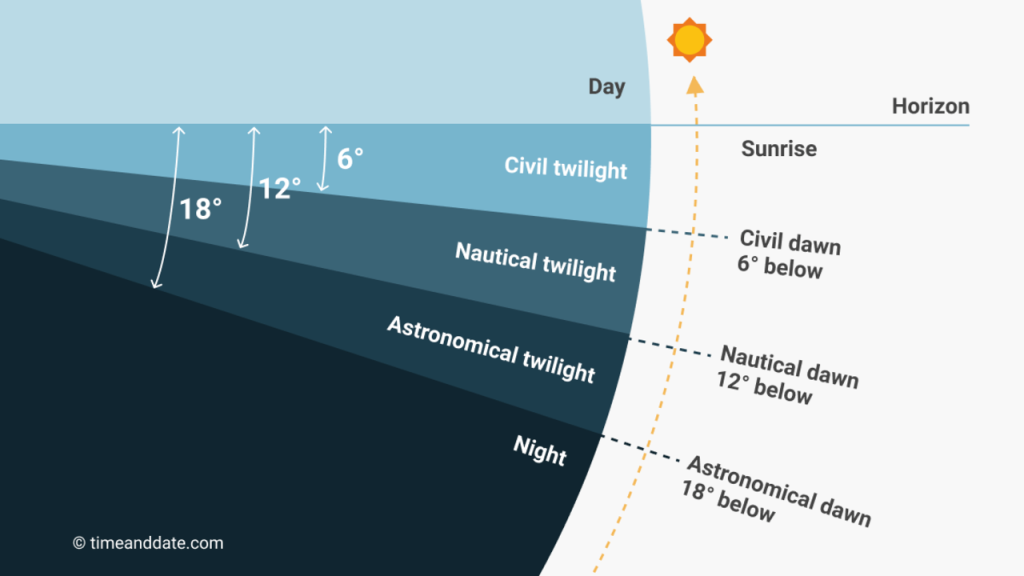
Civil twilight occurs when the centre of the Sun is less than 6 degrees below the horizon. In the morning, civil twilight begins when the Sun is 6 degrees below the horizon and ends at sunrise. In the evening, it begins at sunset and ends when the Sun reaches 6 degrees below the horizon.
Civil twilight is the brightest form of twilight. There is enough natural sunlight during this period that artificial light may not be required to carry out outdoor activities. Only the brightest celestial objects can be observed by the naked eye during this time.
Nautical twilight occurs when the centre of the Sun is between 6 degrees and 12 degrees below the horizon. This twilight period is less bright than civil twilight, and artificial light is generally required for outdoor activities.
The term nautical twilight dates back to the time when sailors used the stars to navigate the seas. During this time, most stars can be easily seen with the naked eye, and the horizon is usually also visible in clear weather conditions.
Astronomical twilight occurs when the centre of the Sun is between 12 degrees and 18 degrees below the horizon.During astronomical twilight, most celestial objects can be observed in the sky. However, the atmosphere still scatters and refracts a small amount of sunlight, and that may make it difficult for astronomers to view the faintest objects.
Before astronomical dawn and after astronomical dusk, it is astronomical nighttime, when no indirect sunlight is visible, and even faint celestial objects can be seen, weather permitting.